File Mover Blog

  • 26 Apr

    Source file parsing and vlookup configuration

    Q: Source file parsing request:
    It was a pleasure meeting you this morning, we had a productive time upgrading our lower-environment server.
    Now, I have a specific requirement, I want to know if this is doable in Limagito?
    I have attached 3 source log files, and an Excel file for lookup values.
    Let me know what is possible and what isn’t.
    Your help would be appreciated.
           Requirement is.
    1. Get a portion of the sourcefilename
      -Filename is: 3294006586260310100730.log
      -get 7th position and is 4 digits in length (is the instrument-Slno)
      -Lookup for slno in the csv file for a possible match
      -in the 1st column (match just the 1st 4 digits alone)
      -and get the associated value in the 2nd column.             (VAR-1)
      -if there isn’t a match, then assign ‘Default‘ to VAR-1
    2. Open source-file
      -and lookup for a static-string ‘Donation ID’:
      -and get the associated value which is on the same line. (VAR-2)
      -if there isn’t a match, then assign ‘None‘ to VAR-2
      -if there are any backward or forward slashes within the value, replace it with space
    3. Rename the Target file name.
      -with the original Primary name
      -and suffix it with ‘-‘
      -and suffix it with (VAR-2)
      -and suffix it with ‘-‘
      -and suffix it with (VAR-1)
      -File Extension should be ‘.TXT
    1. Create a folder with the name (VAR-1) on the Target path and drop the associated renamed file in it.

    A: Yes this is possible using our srcipting option.

    • The Source must be a Windows folder (or share):

    limagito filemover windows folder or share as source

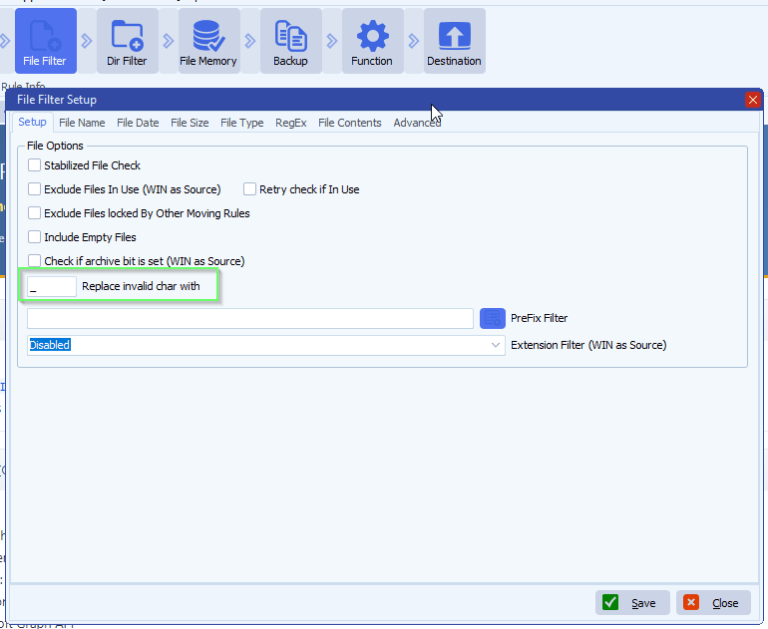
    • As file filter we used *.log because we only need to search for log files:

    limagito filemover file filter setup

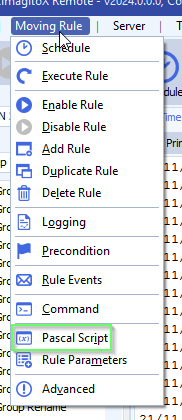
    • Open our Pascal Script option:

    limagito filemover pascal script option

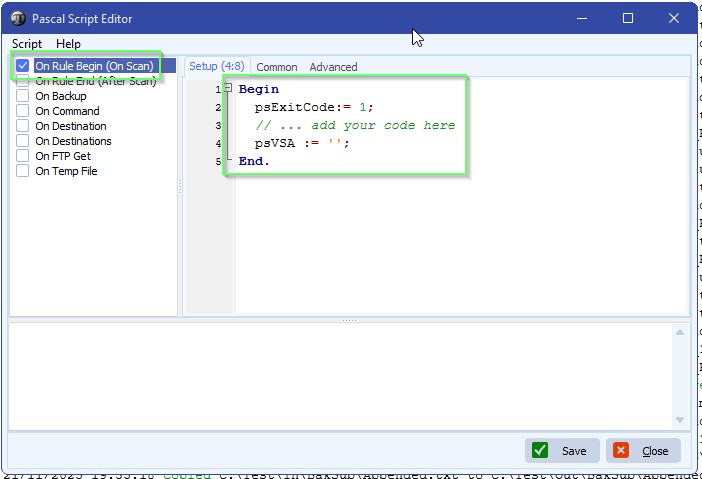
    • Enable and add the following ‘On Rule Begin’ script:
      • This script will load the content of the ‘AssetID_with_SerialNumber.csv’ file. You can adjust the ctCsvFile const if needed.
      • It must be a csv file
      • You can download the script here

    limagito filemover pascal script source file parsing

    • Funtion setup:
      • We are using ‘Move Files’ in our test setup
      • If you want to keep the files in the source then
        • Select ‘Copy Files’ instead
        • Enable our File Memory option! This way we will only copy the same file once.

    limagito filemover function setup

    • Destination Setup
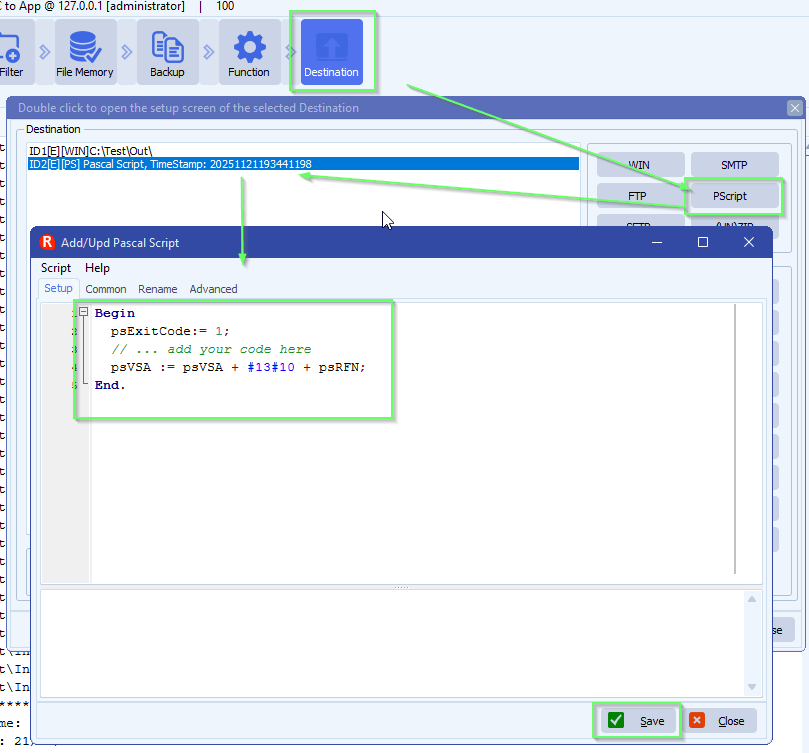
      • First Destination MUST be our Pascal Script option
      • Second Destination is the destination folder of moved log files

    limagito file mover destination setup

    • First Destination: Pascal Script
      • You can download the script here
      • The script will strip an ID from the source filename (Char 7 – 10)
      • This ID will be used to get the ‘AssetID’ from the csv file
      • AssetID will be used to parse the source file for the ‘Donation ID’ information
        • / and  \ will be replaced with a space
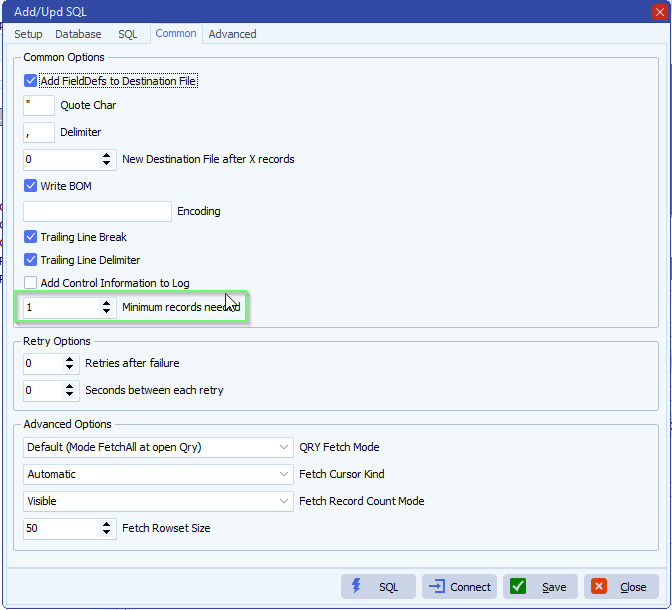
        • Invalid directory char will be removed

    limagito filemover source file parsing

    • Second Destination: We used a Windows Folder but can be any other destination type

    limagito file mover windows folder as destination

    • Adjust ‘Create Subdir, opt.’ to:  %VSB\%SFS
      • %VSB var contains the AssetID parsed from the csv file

    limagito filemover file and directory setup

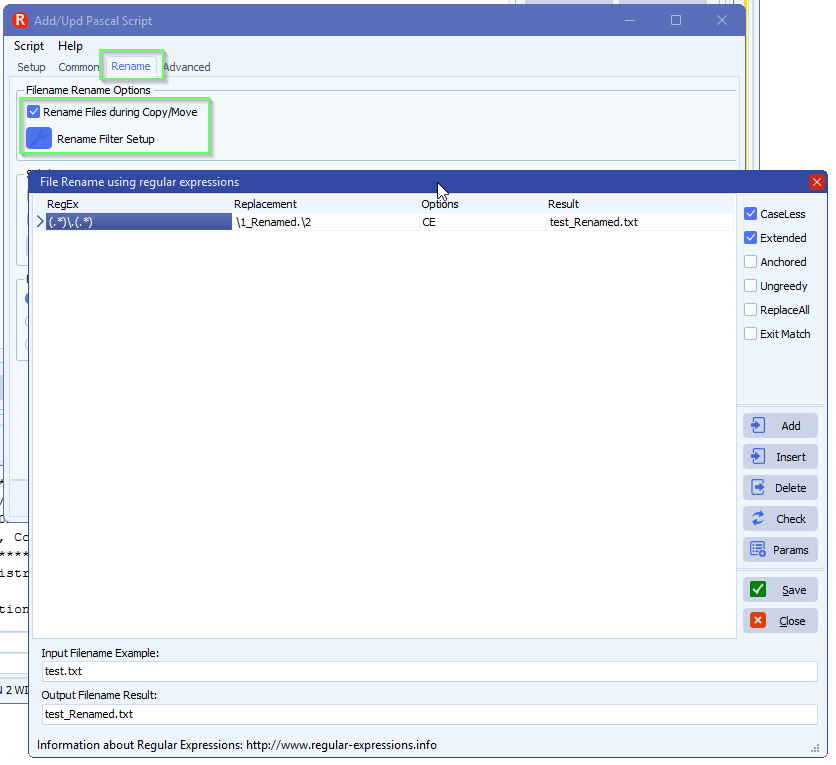
    • Enable ‘Rename Files during Copy/Move’ option:

    limagito filemover file renaming option

    • File Rename setup:
      • RegEx:  (.*)\.(.*)
      • Replacement:  \1-%VSC-%VSB.log
        • Filename will be renamed and extension will change from .log to .txt

    limagito filemover file renaming setup

    • RunTime Log result:

    limagito file mover runtime log result

    If you need any help about this ‘source file parsing’ request, please let us know.

    Best Regards,

    Limagito Team

    #csv #managedfiletransfer #filetransfer #filemanagement #limagito

  • 14 Apr

    How to use Microsoft Graph API with OneDrive as source and destination

    Using Microsoft Graph API with OneDrive

    On request we added support for Microsoft Graph as API method in version v2026.4.14.0.

    Limagito FileMover Setup

    • Setup
      • Graph Url is fixed, should be https://graphMicrosoft.com
      • Set Directory, in our example: /Attachements
      • Select the Auth Type you will be using, check the previous blog articles:
        • Online Authentication using Client Credentials without User Dialog
          • This means ‘Application permissions’ in your Azure App Registration
        • OAuth 2.0 authorization code flow
          • This means ‘Delegated permissions’ in your Azure App Registration


    • The following example uses ‘Online Authentication using Client Credentials without User Dialog’
      • In this case, you need to add the User Principal Name (email address, example: user@contoso.com)
      • Do not forget to add Graph Application permissions in your Azure App Registration

    limagito file mover Microsoft Graph API with OneDrive

    • OAuth2 setup:
      • Enable ‘Code Challenge’
      • Enable ‘Include Nonce’
      • Leave ‘Authorization Endpoint URL’ empty, not used with ‘Online Authentication using Client Credentials without User Dialog’
      • Set ‘Token Endpoint URL’
        • https://login.microsoftonline.com/%realm/oauth2/v2.0/token
        • %realm will be replaced by the Realm value = Directory (tenant) ID. You can also enter the full URL including the Tenant.
      • Enter your Client ID and Client Secret
        • Azure > App Registrations > Select the App you created > Use ‘Application (client) ID’ as Client ID in Limagito OneDrive OAuth2 setup
      • Azure > Certificates & Secrets > Client secrets > Use ‘Value’ field as Client Secret in Limagito OneDrive OAuth2 setup
      • Set ‘Scope’ to: https://graph.microsoft.com/.default
        • Don’t forget to add “File.ReadWrite” to the Permissions in your Azure setup.
          • Permissions Type must be Delegated with “OAuth 2.0 authorization code flow”
          • Permissions Type must be Application with “Online Authentication using Client Credentials without User Dialog”
          • FYI: Delegated permissions, also called scopes, allow the application to act on behalf of the signed-in user.
      • Leave Resource empty
      • Leave Response Mode empty to omit the default response_mode “query” param.
      • Leave Response Type empty, this way the default value “code” will be used.
      • Redirect URI is not used with ‘Online Authentication using Client Credentials without User Dialog’
      • When using %realm in the ‘Authorization or Token Endpoint URL’
        • Please set ‘Realm’ to your Tenant of Tenant_ID

    limagito file mover onedrive oauth2 setup

    If you need any help about this ‘microsoft Graph API with OneDrive’ option, please let us know.

    Best Regards,

    Limagito Team

    #onedrive #managedfiletransfer #filetransfer #filemanagement #limagito
    By Limagito-Team OneDrive ,
  • 11 Apr

    How to use Microsoft Graph API with SharePoint as source and destination

    Using Microsoft Graph API with SharePoint

    On request we added support for Microsoft Graph as API method in version v2026.4.11.0. So, from this version on we support:

    • Sharepoint REST API (legacy)
    • Microsoft Graph API

    Limagito FileMover Setup

    limagito file mover sharepoint authentication type

      • Set “Microsoft Graph API’ as API Method

    limagito file mover microsoft Graph API with SharePoint

    • OAuth2 setup:
      • Enable ‘Code Challenge’
      • Enable ‘Include Nonce’
      • Set ‘Authorization Endpoint URL’
        • https://login.microsoftonline.com/%realm/oauth2/v2.0/authorize
        • %realm will be replaced by the Realm value = Directory (tenant) ID. You can also enter the full URL including the Tenant.
      • Set ‘Token Endpoint URL’
        • https://login.microsoftonline.com/%realm/oauth2/v2.0/token
        • %realm will be replaced by the Realm value = Directory (tenant) ID. You can also enter the full URL including the Tenant.
      • Enter your Client ID and Client Secret
        • Azure > App Registrations > Select the App you created > Use ‘Application (client) ID’ as Client ID in Limagito SharePoint OAuth2 setup
      • Azure > Certificates & Secrets > Client secrets > Use ‘Value’ field as Client Secret in Limagito SharePoint OAuth2 setup
      • Set ‘Scope’ to: openid offline_access https://graph.microsoft.com/.default
        • Don’t forget to add “Sites.ReadWrite.All” to the Permissions in your Azure setup.
          • Permissions Type must be Delegated with “OAuth 2.0 authorization code flow”
          • Permissions Type must be Application with “Online Authentication using Client Credentials without User Dialog”
          • FYI: Delegated permissions, also called scopes, allow the application to act on behalf of the signed-in user.
        • An alternative could be: openid offline_access https://graph.microsoft.com/Sites.ReadWrite.All
      • Leave Resource empty
      • Leave Response Mode empty to omit the default response_mode “query” param.
      • Leave Response Type empty, this way the default value “code” will be used.
      • The Redirect URI should be http://localhost/   (and not https://localhost/)
        • Be sure to add the redirect URI in Azure too, combined with the Redirect Port in the example it would be:  http://localhost:3017
        • Check if you selected “Web” as Redirect URI Type in Azure (do not use mobile & desktop or SPA)
      • RedirectPort, we used 3017
      • When using %realm in the ‘Authorization or Token Endpoint URL’
        • Please set ‘Realm’ to your Tenant of Tenant_ID

    limagito file mover sharepoint oauth2 setup

    Azure App Registrations

    • Register an application > + New registration

    limagito file mover azure app registrations

    • Set Name, Single tenant and Web as Redirect URI

    limagito file mover azure app registrations

    • You’ll need the Application (Client) ID in the OAuth2 setup of Limagito File Mover. Also Directory (Tenant) ID will be used.

    limagito file mover azure app registrations

    • Depending on the ‘Authentication Type’ in Limagito File Mover, you’ll need a Redirect URI.

    limagito file mover azure register an application

    • It is http://localhost:3017 and NOT https://

    limagito file mover azure register an application

    • Summary:

    limagito file mover azure register an application

    limagito file mover azure register an application

    limagito file mover azure register an application

    • Add a new client secret:

    limagito file mover azure app registrations

    • Set Client secret description and expire period:

    limagito file mover azure app registrations

    • IMPORTANT: we’ll need the Value as Client Secret in the OAuth2 setup of Limagito File Mover. The Secret ID is NOT needed.

    limagito file mover azure app registrations

    • Add API Permissions, two types of permissions:
      •  Application permissions allow the app to access data on its own, without a signed-in user. The app acts as itself using its own identity. This is used with client credentials authentication (client ID + secret or certificate). The app has access to all resources that the permission grants — for example, Sites.ReadWrite.All as an application permission gives access to all SharePoint sites in the tenant.
      • Delegated permissions allow the app to act on behalf of a signed-in user. The app can only access what the user themselves can access. This is used with the OAuth 2.0 authorization code flow where a user signs in through a browser dialog. For example, Sites.ReadWrite.All as a delegated permission gives the app access only to the SharePoint sites that the signed-in user has permission to use.
      • In short: application = the app acts as itself (no user), delegated = the app acts as the user (user must sign in once during OAuth2 setup).

    limagito file mover azure app registrations

    • Select Microsoft Graph:
      • First option is it to use Application permissions: we added Sites.ReadWriteAll

    limagito file mover azure app registrations

    limagito file mover azure app registrations

    • Select Microsoft Graph:
      • Second option is it to use Delegated permissions: again we added Sites.ReadWriteAll

    limagito file mover azure app registrations

    • Grant admin consent for the choosen Application permissions:

    limagito file mover azure app registrations

    • Confirm

    limagito file mover azure app registrations

    • Permissions result:

    limagito file mover azure app registrations


    If you need any help about this ‘microsoft Graph API with SharePoint’ option, please let us know.

    Best Regards,

    Limagito Team

    # sharepoint #managedfiletransfer #filetransfer #filemanagement #limagito
    By Limagito-Team SharePoint ,
1 2 3 4 170
SEARCH